

Why choose us
Our Factory
We have a 44,000 m² production base for various auxiliary parts processing, component welding, finished product inspection, and packaging. Our facility features multiple production lines and is equipped with modern production and processing equipment, as well as online ERP, MES, and OA management systems. We produce a wide range of heat exchange products, with an annual output of up to 1 million units (sets).
Complete Process System
Our ERP and PDM systems enable information management, systematic operations, and quality control.
Best Energy Solutions
With over two decades of experience in the wind energy sector, we have a capacity of over 17,900 MW.
End-to-End Services
We have extensive experience in power evacuation, land procurement liaison, and working with state authorities.
A plate heat exchanger is a type of heat exchanger that uses metal plates to transfer heat between liquids. Compared to conventional heat exchangers, plate heat exchangers offer better heat transfer efficiency because the liquids are exposed to a larger surface area, which speeds up the heat transfer process.
Unlike shell and tube heat exchangers, plate heat exchangers require a smaller temperature difference between the hot and cold liquids. For plate heat exchangers, this temperature difference can be as low as 1°C, whereas shell and tube heat exchangers typically require a difference of around 5°C or more. Additionally, plate heat exchangers are smaller in size compared to shell and tube heat exchangers, which means they require less installation space. If you need to increase or reduce the heat transfer area, this can be easily achieved by adding or removing plates.


Pros of Gasketed Plate Heat Exchangers
Efficiency
Due to their large surface area, these heat exchangers are very efficient at transferring heat, which leads to energy savings.
Compact Size
The design allows for a high heat transfer area within a small footprint, which is beneficial in areas with limited space.
Flexible Design
The number of plates can be added or removed to increase or decrease the heat transfer area, providing great flexibility.
Ease of Maintenance
The bolted design facilitates easy disassembly for cleaning, maintenance, or replacement of heat exchanger plates and gaskets.
Types of Plate Heat Exchangers
There are four main types of plate heat exchangers:
Gasket Plate Heat Exchangers: Multiple sheets of thin metal are arranged to form channels in gasket-style heat exchangers. By inserting or removing internal plates, gasket plate heat exchangers can increase or decrease their heating or cooling capability. They can also be disassembled for cleaning and repair purposes. The plates are generally made of stainless steel, sometimes platinum; the endplates are typically made of mild steel, and the gaskets are usually made of rubber. Gasket plate heat exchangers can be used in a variety of heavy-duty HVAC, automotive, and process engineering applications. Despite their small size, they offer extraordinarily high thermal efficiency. These heat exchangers use high-quality gaskets and a well-designed seal to keep the plates together and prevent leaks. Plates can be quickly removed for cleaning, extension, or replacement, significantly lowering maintenance costs.
Welded Plate Heat Exchangers: Similar to gasket plate heat exchangers, welded plate heat exchangers feature plates that are welded together instead of bolted. These heat exchangers are highly robust and suitable for handling hot or corrosive fluids. Since the plates are welded, mechanical plate washing is not possible, unlike with gasketed plate heat exchangers.
Semi-Welded Plate Heat Exchangers: Semi-welded plate heat exchangers combine both welded and gasketed plates. They consist of pairs of plates that are welded together and gasketed on other pairs, as one fluid path is welded and the other is gasketed. This design provides ease of service while still being capable of handling more intense fluids. With a relatively low chance of fluid loss, semi-welded heat exchangers are ideal for transferring heavy materials.
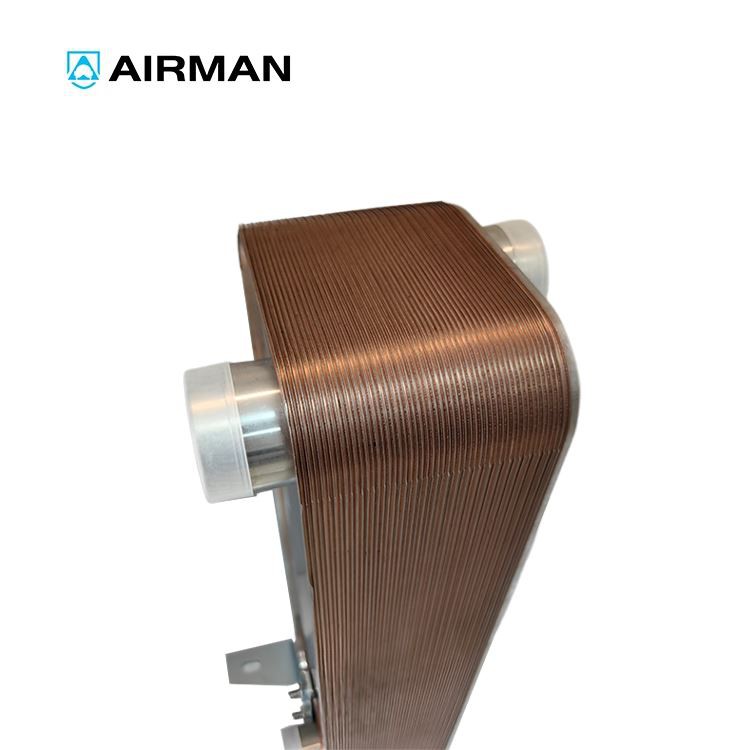
Brazed Plate Heat Exchangers: Typically used in smaller applications, brazed plate heat exchangers are increasingly being manufactured in larger sizes for industrial use. They are found in a wide range of automotive and refrigeration applications. Highly corrosion-resistant due to the stainless-steel plates and copper brazing, brazed plate heat exchangers are economical, efficient, and lightweight. The plates are thin and are brazed together to form a complete seal. This seal and the positioning of the plates determine the flow channels for each fluid. The unit is designed to enhance heat transfer and endure both high temperatures and high-pressure conditions.
Industrial Applications of Plate Heat Exchangers

HVAC (Heating, Ventilation, and Air Conditioning):
Plate heat exchangers are used in HVAC systems to recover heat from exhaust air and preheat incoming fresh air, improving energy efficiency and reducing heating costs.
Food and Beverage Industry:
In the food and beverage industry, plate heat exchangers are used for pasteurization, sterilization, and cooling of products such as milk, juices, and sauces.
They are also employed for heating or cooling water for various food processing applications.
Chemical Processing:
Plate heat exchangers are used for temperature control, condensation, and evaporation processes in chemical manufacturing.
They are often used in applications involving corrosive or aggressive fluids due to their easy maintenance and material options.
Petrochemical Industry:
Plate heat exchangers play a critical role in refining processes by cooling or heating fluids such as crude oil, hydrocarbons, and various chemicals.
Power Generation:
Plate heat exchangers are used in power plants for cooling and condensing steam to improve the efficiency of power generation processes, such as in condensers.
Pharmaceutical Industry:
They are used for precise temperature control and pasteurization of pharmaceutical products and for providing clean and sterile conditions in pharmaceutical processes.
Waste Heat Recovery:
In industrial facilities, plate heat exchangers are employed to recover waste heat from exhaust gases or process streams and use it to preheat or generate steam, thereby reducing energy consumption.
Marine and Shipping:
Plate heat exchangers are used in marine applications for cooling and heating purposes in engines, air conditioning systems, and other onboard equipment.
Brewing Industry:
Plate heat exchangers are used for cooling wort (unfermented beer) during the brewing process, which is crucial for achieving the desired flavor and quality in beer production.
Oil and Gas Industry:
They are used for heating and cooling in oil and gas processing, including heat exchange in natural gas liquefaction and regasification processes.
Swimming Pool Heating:
Plate heat exchangers are used to heat swimming pools, providing an energy-efficient solution for maintaining water temperature.
Chemical Engineering:
Plate heat exchangers are utilized in chemical engineering for various processes, including distillation, crystallization, and heat recovery.
Two different fluids with different temperatures flow through the heat exchanger: one flows through the inner pipes, and the other flows through the outer sleeve. Heat is transferred from one fluid to the other according to Newton’s heat transfer laws. This method of heat transfer can be applied in various settings, primarily in the heating systems of modern buildings, ensuring energy recovery. For example, steam from a steam-generating plant can be used to heat water in the plant through a plate heat exchanger.
The working principle of the plate heat exchanger is fundamentally the same across different designs, though variations in pipe and channel configurations exist. The design required depends on the desired fluid temperature, with common designs including single-pass, double-pass, or four-pass configurations.
These numbers indicate how the pipes and fluid paths are arranged within the exchanger. In a single-pass heat exchanger, the fluid enters from one side and exits from the other. Two-pass and four-pass designs are often used because they allow the fluid to enter and exit from the same side, simplifying construction and improving efficiency.
The general concept in designing a heat exchanger involves using ducts or similar profiles to transfer heat between a cold and a hot liquid. In summary, the plate heat exchanger operates within a closed chamber where fluids circulate through pipes and channels without mixing. The pipe walls are typically made of stainless steel, and the heat is transferred from the fluid to the outer chamber, which is constructed from plastic or another material with high thermal capacity to minimize heat dissipation.
The plate heat exchanger's design enhances heat transfer rates by using baffles within the closed chamber. These baffles create compartments that are thinned to maximize contact with the fluid and increase heat transfer efficiency. The plates are designed with a large surface area to facilitate rapid heat transfer.
In essence, the working principle of a plate heat exchanger involves fluids flowing through channels on the plates, separated by gaskets, without mixing. Heat transfer occurs due to the temperature difference between the fluids. The flow directions on the plates promote turbulence, which supports the formation of high heat transfer coefficients.
Components of Plate Heat Exchangers
Heat Transfer Plates: These are the core components of the plate heat exchanger. They are thin, corrugated metal plates made from materials such as stainless steel, titanium, or other alloys. The corrugations create turbulence and increase the surface area, enhancing heat transfer efficiency between the two fluids.
Frame: The frame or frame assembly holds the heat transfer plates in place, ensuring proper alignment and spacing. It also provides structural support to the heat exchanger.
End Plates: Positioned at both ends of the heat exchanger stack, the end plates contain the fluid flow within the channels formed by the plates. They also have openings for the inlet and outlet connections of the hot and cold fluids.
Gaskets or Seals: Gaskets are placed between the plates to prevent the mixing of the two fluids and maintain a tight seal. They are typically made of elastomeric materials like rubber or EPDM. Gaskets also create the flow channels for the fluids.
Connections: Inlet and outlet ports or connections allow the hot and cold fluids to enter and exit the plate heat exchanger. These connections are usually located on the end plates.
Guiding Bars or Posts: Some plate heat exchangers include guiding bars or posts that help align the plates during assembly and ensure consistent plate spacing.
Pressure Plates: Pressure plates apply pressure to the heat transfer plates, gaskets, and frame, compressing them together to maintain a tight seal. The pressure is applied by tightening bolts or clamping mechanisms on the frame.
Manifolds: These components help direct the flow of hot and cold fluids. Manifolds may be integral to the frame or added as separate components.
Our Factory
We have a 44000m² production base for various auxiliary parts processing, component welding, finished product inspection, packaging, etc. There are multiple production lines, and equipped with modern production and processing equipment and online ERP, MES, OA management systems to produce various heat exchange products, with an annual output of up to 1 million units (sets).
FAQ
Hangzhou Airman Environmental Technology Co., Ltd. is one of the most professional plate heat exchanger manufacturers and suppliers in China, specialized in providing high quality products. We warmly welcome you to buy customized plate heat exchanger made in China here from our factory.
plate heat exchanger investigations, plate heat exchanger customer, plate heat exchanger promotion