

As a supplier of simple heat exchangers, I often encounter questions about the log - mean temperature difference (LMTD). It's a fundamental concept in the field of heat transfer, and understanding it is crucial for the proper design, operation, and evaluation of heat exchangers.
Understanding the Basics of Heat Exchangers
Before delving into the log - mean temperature difference, let's briefly review what a simple heat exchanger is. A heat exchanger is a device that transfers heat from one fluid to another. In a simple heat exchanger, two fluids at different temperatures flow either in parallel, counter - flow, or cross - flow arrangements. The purpose is to either heat a cold fluid or cool a hot fluid, depending on the application.
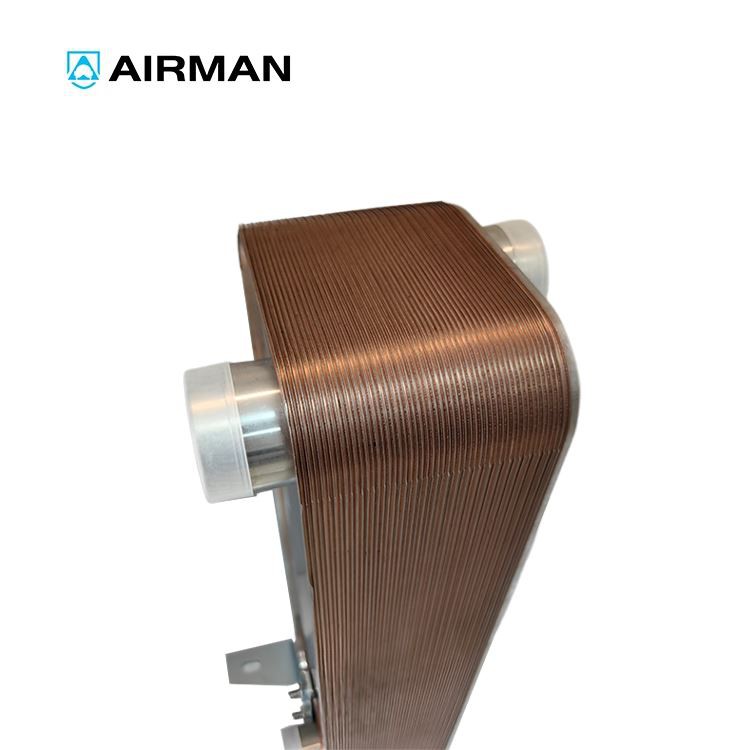
For instance, in a domestic hot water system, a Plate Heat Exchanger For Domestic Hot Water can be used to transfer heat from a hot water source, like a boiler, to the cold incoming water. In industrial settings, Industrial Plate Heat Exchanger are employed for various processes such as cooling of machinery or heating of chemical solutions. Smaller applications might use Small Plate Heat Exchanger, for example, in laboratory equipment or small - scale food processing.
The Concept of Temperature Difference in Heat Transfer
The rate of heat transfer in a heat exchanger is directly related to the temperature difference between the two fluids. The greater the temperature difference, the higher the rate of heat transfer. However, in a heat exchanger, the temperature difference between the two fluids changes along the length of the exchanger.
Consider a counter - flow heat exchanger, where the hot and cold fluids flow in opposite directions. At one end of the exchanger, the hot fluid enters at a high temperature (T_{h1}) and the cold fluid enters at a low temperature (T_{c1}). At the other end, the hot fluid exits at a lower temperature (T_{h2}), and the cold fluid exits at a higher temperature (T_{c2}).
The temperature difference at the inlet (\Delta T_1=T_{h1}-T_{c2}) and at the outlet (\Delta T_2 = T_{h2}-T_{c1}). Since the temperature difference varies continuously along the length of the heat exchanger, using a simple average of (\Delta T_1) and (\Delta T_2) would not accurately represent the driving force for heat transfer.
Defining the Log - Mean Temperature Difference (LMTD)
The log - mean temperature difference (LMTD) is a more accurate way to represent the average temperature difference between the two fluids in a heat exchanger. It takes into account the non - linear variation of the temperature difference along the length of the exchanger.
The formula for calculating the LMTD is given by:
[LMTD=\frac{\Delta T_1-\Delta T_2}{\ln\left(\frac{\Delta T_1}{\Delta T_2}\right)}]
where (\Delta T_1) and (\Delta T_2) are the temperature differences at the two ends of the heat exchanger.
Significance of LMTD in Heat Exchanger Design
The LMTD is a key parameter in the design of heat exchangers. The heat transfer rate (Q) in a heat exchanger is given by the equation:
[Q = U\times A\times LMTD]

where (U) is the overall heat transfer coefficient, which depends on the properties of the fluids, the type of heat exchanger, and the flow conditions, and (A) is the heat transfer area.
By knowing the required heat transfer rate (Q), the overall heat transfer coefficient (U), and calculating the LMTD, we can determine the necessary heat transfer area (A) for the heat exchanger. This is crucial for sizing the heat exchanger correctly. If the LMTD is underestimated, the heat exchanger may be undersized, resulting in insufficient heat transfer and not meeting the process requirements. On the other hand, overestimating the LMTD may lead to an oversized and more expensive heat exchanger.
LMTD for Different Flow Arrangements
The calculation of LMTD varies slightly depending on the flow arrangement in the heat exchanger.
Parallel - Flow Heat Exchangers
In a parallel - flow heat exchanger, both the hot and cold fluids flow in the same direction. The temperature difference at the inlet (\Delta T_1=T_{h1}-T_{c1}) and at the outlet (\Delta T_2=T_{h2}-T_{c2}). The LMTD is still calculated using the same formula (\frac{\Delta T_1 - \Delta T_2}{\ln\left(\frac{\Delta T_1}{\Delta T_2}\right)}).
However, in a parallel - flow heat exchanger, the temperature difference between the two fluids decreases continuously along the length of the exchanger. This limits the maximum temperature to which the cold fluid can be heated or the minimum temperature to which the hot fluid can be cooled.
Counter - Flow Heat Exchangers
Counter - flow heat exchangers are generally more efficient than parallel - flow heat exchangers. As mentioned earlier, the temperature difference at the inlet (\Delta T_1=T_{h1}-T_{c2}) and at the outlet (\Delta T_2=T_{h2}-T_{c1}).
In a counter - flow arrangement, the temperature difference between the two fluids remains more uniform along the length of the exchanger. This allows for a greater temperature change of the fluids and a higher LMTD compared to a parallel - flow heat exchanger for the same inlet and outlet temperatures.
Cross - Flow Heat Exchangers
Cross - flow heat exchangers have a more complex flow pattern, where the two fluids flow perpendicular to each other. The calculation of the LMTD for cross - flow heat exchangers is more involved and often requires the use of correction factors. These correction factors are based on the degree of mixing of the fluids and the flow arrangement (e.g., one - pass or multi - pass).
Factors Affecting the LMTD
Several factors can affect the LMTD in a heat exchanger:
Fluid Flow Rates
Changing the flow rates of the hot and cold fluids can alter the inlet and outlet temperatures, and thus the LMTD. For example, increasing the flow rate of the cold fluid may result in a lower exit temperature of the hot fluid and a higher exit temperature of the cold fluid, which will change (\Delta T_1) and (\Delta T_2) and ultimately the LMTD.
Fluid Properties
The specific heat, density, and viscosity of the fluids can influence the heat transfer process and the temperature profiles. Fluids with higher specific heat require more heat to change their temperature, which can affect the inlet and outlet temperatures and the LMTD.
Fouling
Fouling occurs when deposits build up on the heat transfer surfaces of the exchanger over time. This reduces the overall heat transfer coefficient (U) and can also affect the temperature profiles of the fluids. As a result, the LMTD may change, and the heat transfer performance of the exchanger may degrade.
Applications of LMTD in Our Simple Heat Exchangers
At our company, as a supplier of simple heat exchangers, we use the concept of LMTD in various ways. When a customer approaches us with a specific heat transfer requirement, we first analyze the inlet and outlet temperatures of the hot and cold fluids. Using the LMTD formula, we calculate the average temperature difference.
Based on the required heat transfer rate and the calculated LMTD, we select the appropriate type of heat exchanger (parallel - flow, counter - flow, or cross - flow) and determine the necessary heat transfer area. We also consider factors such as the fluid properties, flow rates, and potential fouling to ensure the long - term performance of the heat exchanger.
Conclusion and Call to Action
Understanding the log - mean temperature difference (LMTD) is essential for anyone involved in the design, operation, or maintenance of heat exchangers. As a supplier of simple heat exchangers, we have the expertise and experience to use the LMTD concept effectively to provide you with the best - suited heat exchanger for your application.
If you are in need of a heat exchanger for your domestic hot water system, industrial process, or any other application, we invite you to contact us for a detailed discussion. Our team of experts can help you determine the right heat exchanger based on your specific requirements, taking into account the LMTD and other important factors. Let's work together to ensure efficient and reliable heat transfer in your processes.
References
- Incropera, F. P., & DeWitt, D. P. (2002). Fundamentals of Heat and Mass Transfer. Wiley.
- Holman, J. P. (2002). Heat Transfer. McGraw - Hill.